Omega x Swatch Mission to the Sun Solar Eclipse Brings a Rare 2026 Release Into Focus
Just a few weeks after the unusual Mission to the Moon 1969 appeared, Omega and Swatch have returned to the MoonSwatch story with something very different. This time there is no gold dial, no elaborate anniversary message and no attempt to make the watch feel more expensive than the familiar Bioceramic models. Instead, the new Mission to the Sun Solar Eclipse takes one of the simplest MoonSwatch designs and changes only a handful of details.
That sounds modest, but in this case it makes sense. The watch was created around the total solar eclipse of 12 August 2026 and was offered in Spain for that day only. Rather than inventing an entirely new MoonSwatch, Swatch used the existing Mission to the Sun as its starting point and altered the details that connect directly with the eclipse.
For anyone who has followed the collection since 2022, that approach feels much more convincing than another colour change produced simply to keep the MoonSwatch name in circulation. There is an actual event behind this release, and the watch is tied to a particular place and date. That gives the Omega x Swatch Mission to the Sun Solar Eclipse 2026 a story that is easy to understand without needing a complicated explanation.
A Small Change That Completely Alters the Mission to the Sun
The regular Mission to the Sun has always been one of the brightest watches in the MoonSwatch family. Its solar theme is obvious before you even read the name, which made it an ideal base for an eclipse edition.
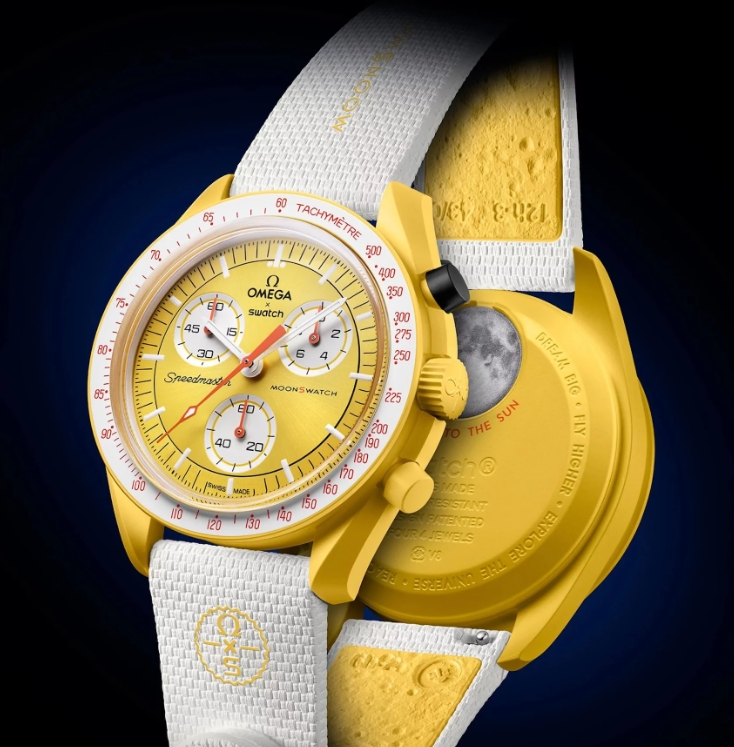
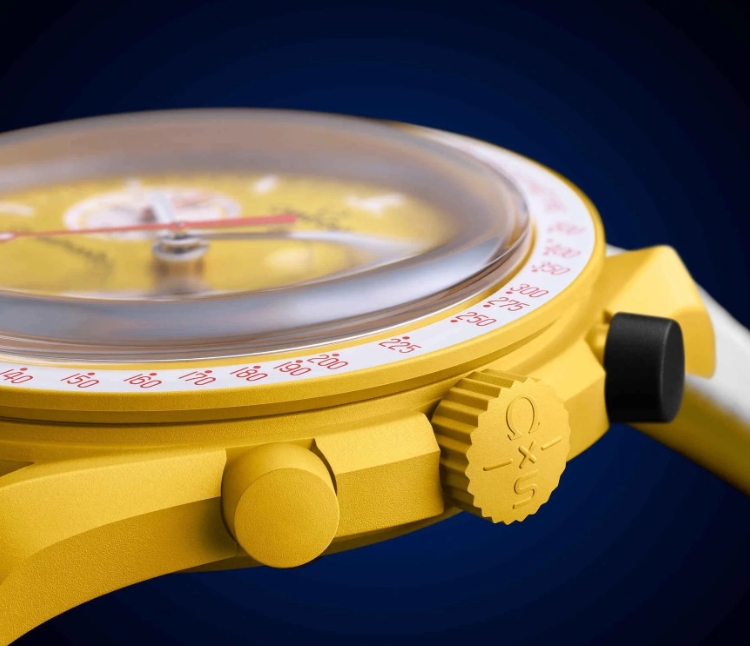
The most noticeable difference on the Solar Eclipse model is found at two o’clock. Swatch replaces the matching chronograph pusher with a black Bioceramic one. Against the much brighter case, that single dark component immediately catches the eye.
It is a surprisingly effective detail. During a solar eclipse the Sun itself does not disappear; it is temporarily obscured by the Moon. The black pusher works in much the same way visually. Instead of covering the whole watch in black or printing an eclipse illustration across the dial, Swatch interrupts the familiar Mission to the Sun colour scheme with one small area of darkness.
That restraint is important. Limited editions often become less attractive when every available surface is used to explain the theme. Here, someone who does not know the background can still see a recognisable MoonSwatch, while an owner who knows the story understands why that black pusher is there.
The Detail on the Back May Be Even Better
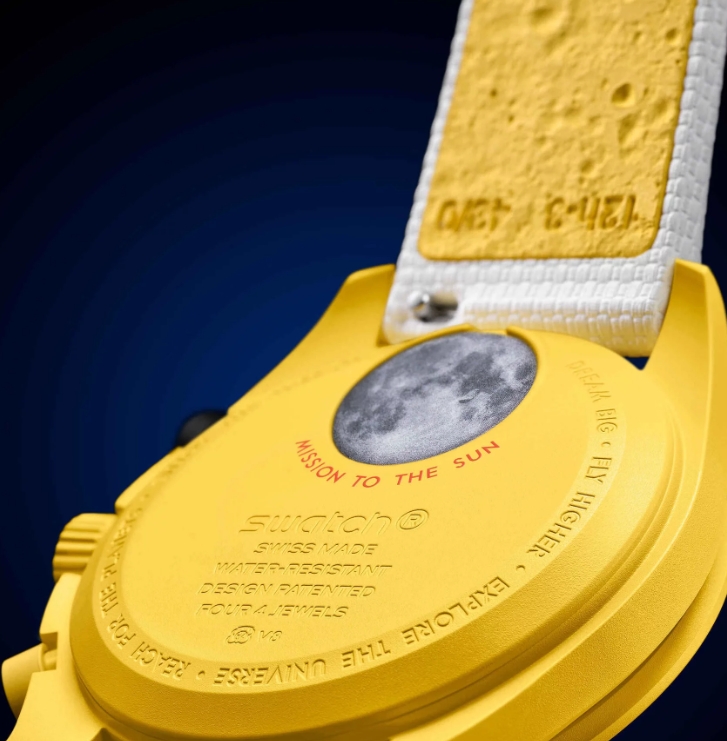
Turn the watch over and the second eclipse reference becomes apparent. The battery cover carries a New Moon design, referring to the lunar phase required for a solar eclipse to occur.
This is exactly the kind of detail that works well on a watch like the MoonSwatch. It does not need to dominate the dial, and it is something an owner discovers rather than something designed simply to attract attention in photographs.
Together, the black pusher and New Moon battery cover give the watch a clear identity without changing the basic character of Mission to the Sun. For collectors comparing MoonSwatch Solar Eclipse design details, those two changes are more important than a long list of cosmetic alterations would have been.
It Is Still Very Much a MoonSwatch
Underneath the eclipse theme, the familiar recipe remains intact. The watch continues to use Swatch’s Bioceramic construction and the Speedmaster-inspired layout that has defined the collaboration from the beginning.
The appeal of the MoonSwatch has never depended on pretending that it is a conventional Omega Speedmaster. The attraction comes from taking one of the most recognisable chronograph designs in watchmaking and interpreting it through Swatch materials, colours and pricing.
That distinction is particularly useful for readers of an Omega replica watches in the UK website. The genuine MoonSwatch itself already demonstrates how dramatically the character of a Speedmaster-inspired watch can change when the materials, movement and production philosophy are altered, even while familiar visual cues remain.
It is therefore more useful to study proportions, dial layout, pusher shape, case finishing and colour accuracy than simply to ask whether a watch resembles a Speedmaster from a distance. Those details are what separate a convincing interpretation from something that merely borrows a familiar silhouette.
The Timing Makes This Release More Interesting
The Solar Eclipse also arrived at an interesting moment for the MoonSwatch collection. In July 2026, Mission to the Moon 1969 had taken the collaboration in a surprisingly elaborate direction, using genuine 18K Moonshine Gold for prominent exterior components and connecting the watch directly with the anniversary of the first Moon landing.
The Solar Eclipse follows almost immediately, yet it does practically the opposite.
Rather than increasing the material value, it relies on context. The important element is not gold or a dramatically revised specification. It is the fact that the watch appeared in Spain on the exact date of the eclipse and disappeared with the event.
In some ways, that feels more natural for Swatch. The company has always been comfortable treating watches as cultural objects connected with a particular moment, colour or idea. A one-day MoonSwatch built around an eclipse therefore feels closer to Swatch’s character than an artificially numbered limited edition.
Why Spain Only Actually Makes Sense
For UK buyers, the frustrating part was obvious. This was not a normal British release that enthusiasts could simply pick up from their nearest participating shop. The Solar Eclipse edition was restricted to Spain on 12 August 2026, with availability through the Spanish Swatch website, selected stores and other local sales channels.
That makes the watch difficult for a UK enthusiast to obtain, but the geographical restriction is also a major part of its identity.
If Swatch had released exactly the same watch worldwide for several months, the eclipse connection would have felt considerably weaker. By tying it to Spain and to a single date, the company made the place and occasion part of the object itself.
Whether that ultimately makes the watch desirable on the secondary market is another matter. Scarcity alone does not guarantee lasting collector interest. What it does provide is a clear story, and watches with understandable stories often remain more memorable than editions distinguished only by a new dial colour.
What UK Omega Replica Watch Buyers Can Learn From It
New Omega and MoonSwatch releases inevitably influence the replica market. Colours are copied, dial layouts are recreated and distinctive limited-edition details eventually begin appearing on watches offered by third-party sellers.
The Solar Eclipse model is a useful example of why buyers should look beyond the product name. Reproducing a yellow case is relatively straightforward. Recreating the exact contrast of the black pusher, the appearance of the dial, the battery cover artwork and the overall finish consistently is a different question.
Readers comparing Omega Speedmaster inspired replica watches in the UK should therefore pay attention to the small elements that identify a particular reference rather than relying on phrases such as “AAA”, “1:1” or “Swiss quality”. Those descriptions are widely used by sellers and do not provide a measurable standard on their own.
Our Replica Omega Speedmaster watches section follows these changes across the wider Speedmaster family, looking at how new designs and unusual editions influence what appears in the UK replica market.
For this Solar Eclipse edition in particular, reference photographs and clearly stated specifications matter far more than exaggerated quality labels. A good comparison begins with understanding the genuine watch correctly.
Has MoonSwatch Gone Too Far With Limited Releases?
There is a reasonable argument that the MoonSwatch family now contains more variations than most people can comfortably keep track of. What began in 2022 as an eleven-watch solar-system collection has grown through Moonshine Gold releases, Moonphase references, Earth-inspired models and increasingly specific special editions.
Not every collector will enjoy that pace. Some will understandably see another limited MoonSwatch and wonder whether the concept is being stretched too far.
The Solar Eclipse, however, is one of the easier releases to defend. It does not require a complicated fictional story. There really was a total solar eclipse on 12 August 2026, Spain was directly connected with the event, and Swatch made the watch available there for that day.
There is a neat beginning and end to the idea.
More importantly, the designers resisted the temptation to redesign everything. The limited Mission to the Sun Solar Eclipse MoonSwatch remains recognisable as the existing Mission to the Sun, but the black pusher gives it just enough visual tension to make the eclipse connection obvious once you know what you are looking at.
Final Thoughts
I did not expect another MoonSwatch so soon after Mission to the Moon 1969 to feel particularly interesting. Yet the Solar Eclipse manages to avoid looking like a hurried follow-up because the reasoning behind it is completely different.
The 1969 model used unusual materials and an important moment in space history. Solar Eclipse uses timing, geography and two restrained design changes. One tries to make the MoonSwatch more extraordinary as an object; the other makes an otherwise familiar watch memorable because of when and where it existed.
For UK collectors, the Spain-only availability may be annoying, especially now that the original one-day sale has passed. But that limitation is also what gives the watch much of its personality.
Among the growing number of MoonSwatch variations, this is one release where the limited availability does not feel completely arbitrary. The eclipse happened once on that date, the watch appeared with it, and then the moment was gone. For a collection built around planets, moons and space travel, that is probably as fitting a reason for another MoonSwatch as Swatch could have found.