
UK Best Replica Omega Watches’ Original Flagship Watch Returns To Its Former Glory
Before the Speedmaster went to the moon, before the Seamaster found its way onto James Bond’s wrist, there was the Constellation.
First arriving in 1952, the Constellation was Omega’s first modern flagship watch. Based on the earlier Omega Centenary from 1948, which celebrated 100 years of the brand, the Constellation was a dress watch centered on the theme of precision.
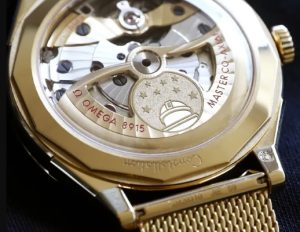
On its caseback was a gold medallion depicting an observatory with eight stars overhead, representing two precision world records and six first-place finishes recorded by cheap Omega copy watches at the Kew-Teddington and Geneva Observatory competitions between 1933 and 1952.
In the ’50s and ’60s, the Constellation was colloquially known simply as “The Swiss Watch,” as it became synonymous with Swiss craftsmanship and accuracy. If you wanted a nice watch in those days, you’d get a Constellation.
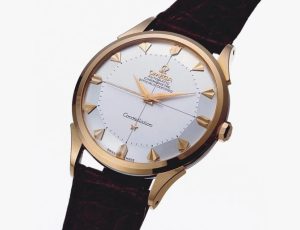
The Constellation, or “Connie,” has always been present in Omega’s catalog since its debut, but its influence has faded over the decades. Prior to today’s release, there were two distinct Constellation lines: the Constellation, an integrated dress watch based on the 1980s “Manhattan” reboot of the model, and the Constellation Globemaster, a more modern dress watch that pulls stylistic influences from disparate vintage Connies. Both are vastly overshadowed by the Speedmaster and Seamaster lines.
But the modern Connie’s second-class citizen status changes as of today, as Swiss Omega fake watches have added a third model series to the line with the Constellation Observatory. Not only does it bring back some of the defining style cues from the oldest, most beloved Constellations, but it also restores the model’s reputation for groundbreaking precision with an impressive new certification.

The stars align
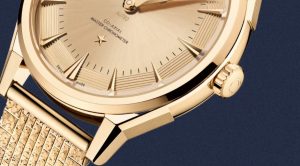
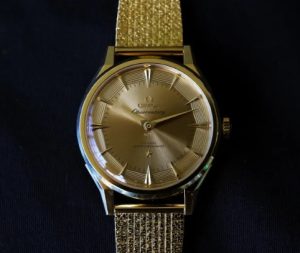
At first glance, the Constellation Observatory looks a lot like a vintage Connie from the 1950s or early ’60s, and that’s by design. AAA clone Omega watches have resurrected several beloved vintage design traits associated with the Constellation for the Observatory, most notably the 12-sided faceted “pie-pan” dial and the angled “dog-leg” lugs.
The Globemaster also had a pie-pan dial, and Omega brought back the dog-leg lugs on a special-edition Seamaster dress watch last year, but this is the first time both iconic design features have appeared on the same watch since 1977, as far as I can tell. The replica Omega watches UK also feature consistent Connie hallmarks, like an applied star above 6:00 on the dial and the aforementioned observatory medallion, which is affixed to the movement’s rotor and visible through a box sapphire caseback.
The pie pan here is considerably more vintage-inspired than what we had on the Globemaster. For starters, the minute markings have been moved onto the raised center of the dial instead of the outer rim, which is how the original pie-pan dials were set up. Top Omega replica watches have also added a hand-guilloché pattern on the facets of the pie pan, a feature introduced on the Constellation in 1953.
The hands and indices of vintage Connies with this fancy pie-pan dial were kite-form and dauphine, respectively. On the Observatory, Omega has kept the general aesthetic while slightly altering both into more elongated, dagger-like shapes to better match the lines of the facets. There’s also no date or seconds hand, leaving a very clean, sharp dial that is simply gorgeous.
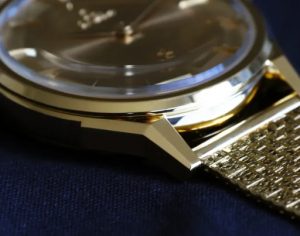
The case, I have to say, is gorgeous as well. It’s fully polished, with the exception of the soldered-on dog-leg lugs. They’re vertically brushed on the sides, with polished angled chamfers on top and bottom, and the tops and bottoms of the lugs themselves polished, too. The lugs are certainly the star of the case, and I just love the way they reflect light. Very few brands do anything interesting with lugs, so I’m very happy that China replica Omega watches have brought back the dog-leg style in a permanent collection.
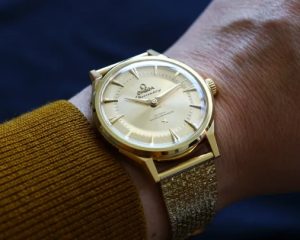
The case measures 39.4mm across and wears a bit larger than you’d think. It’s not super-thin due to tall box sapphire crystals on top and bottom (the thickness is 12.23mm, but a lot of that is from the two domed crystals, with my calipers measuring the case alone at just 8mm thick), and the lugs are a little on the long side at 47.2mm lug to lug.

I’d like to see this in a 36 or 37mm case, since I think that’s more appropriate for a vintage-inspired dress watch, and the Observatory is pushing the limit of sizing for a dress watch. However, even as is, the Omega watches are still plenty wearable and comfortable on my 6.5-inch wrist.
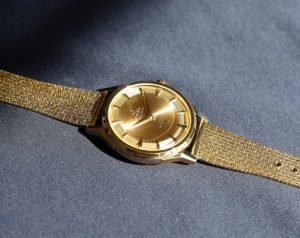
Just one version of the best replica Omega Constellation Observatory watches are available on a bracelet, and it’s the one I tested: reference 140.50.39.21.99.001. This version is in full 18K Moonshine Gold, Omega’s proprietary yellow gold alloy, and that includes the new brick-pattern mesh bracelet.
The underside of the bracelet is fine mesh, and it’s a similar setup to the mesh bracelet you’ll find on some Seamaster Divers like the “No Time to Die” in that it uses holes and a deployant clasp instead of removable links. But this one is more tapered and boasts a smaller clasp with a new locking mechanism. The clasp is even decorated with perlage on the underside.
As for the bracelet itself, its exterior features a very vintage-looking brick pattern that is completely drool-worthy. You just don’t see this style of bracelet very often anymore, and the way Omega was able to engineer it in such a modern way while making it look like it’s from the 1950s is pretty representative of the Constellation Observatory’s masterful mix of old looks and new technology.
Flip the 1:1 Omega fake watches over, and you’ll find a brand-new movement behind that domed sapphire caseback. It’s the Omega Co-Axial Master Chronometer Calibre 8915 (or 8914, depending on the model), and it represents a couple of firsts for Omega and the entire watch industry.
On the version I tested, the movement is the Calibre 8915 Luxe, which features the first Moonshine gold rotor and balance bridge in Omega history. Outside of that, the arabesque Geneva wave pattern is similar to other Omega movements, as are the twin mainspring barrels and the independently adjustable hour hand feature.
What’s more interesting about these new movements is that they’re all certified Master Chronometers. The reason that’s interesting because the Constellation Observatory has no seconds hand. Traditional chronometer certification, whether Master Chronometer certification through METAS or the less stringent COSC certification, requires imagery of the seconds hand to test precision.
But best selling fake Omega watches found a way around this by developing a new sound-based testing method at the Laboratoire de Précision, the independent chronometric certification facility Omega established in 2024, which has already tested over 200,000 chronometers.
The new method records every “tick tock” of the escapement continuously over the entire 25-day testing period while simultaneously recording the effects of temperature, position and atmospheric pressure on the rate. Thanks to this acoustic testing method, which was used in conjunction with optical hand-tracking, the Constellation Observatory is the world’s first Master Chronometer without a seconds hand.
Availability and pricing
I know the modern Constellation and Globemaster have their fans, but they’ve never really done it for me. The Constellation is based on a frankly ugly ’80s design, and the Globemaster feels like it’s trying too hard to compete with Rolex.
The Constellation, with its illustrious history, deserves to be spoken of in the same breath as the Speedmaster and Seamaster. I think the new Observatory is the first step toward making that happen, and it has quietly replaced the Globemaster, which has disappeared from Omega’s website, in the lineup. (Step two is turning the regular Constellation into a more angular, contemporary integrated sports fake Omega watches for sale, but that’s a theory for another time.)
The watch’s looks are dynamite, and the new technology required for the Master Chronometer certification is exactly the type of movement ingenuity that Omega has long excelled at. The only things I’d change are I’d make the case a bit smaller, and I’d change the crown to a decagonal one like on ’50s and ’60s Connies. That’s it.
At launch, there are nine references for the Constellation Observatory. The full Moonshine Gold version I tested tops out the range at $59,100. On a leather strap, it’s $37,900. In descending order by price, there are also versions in platinum ($57,800), Canopus (white) Gold ($44,000) and Sedna (rose) Gold ($37,900), all on leather.
I’m happy to report there are also four steel references at launch, all with cases in Omega’s proprietary O-MegaSteel, which is more scratch-resistant and has a brighter luster than 316L stainless steel. The green, blue and silver dials all come on leather straps and feature stamped rather than hand-guilloche patterns. They retail for $10,900.
Lastly, and perhaps best-looking of the entire collection, is a version with a black ceramic pie-pan dial, which was apparently quite the feat to craft. It’s the only one that foregoes the guilloche pattern on the dial, and it looks cleaner for it. Heavy Don Draper vibes with this black beauty, which retails for $12,200.